
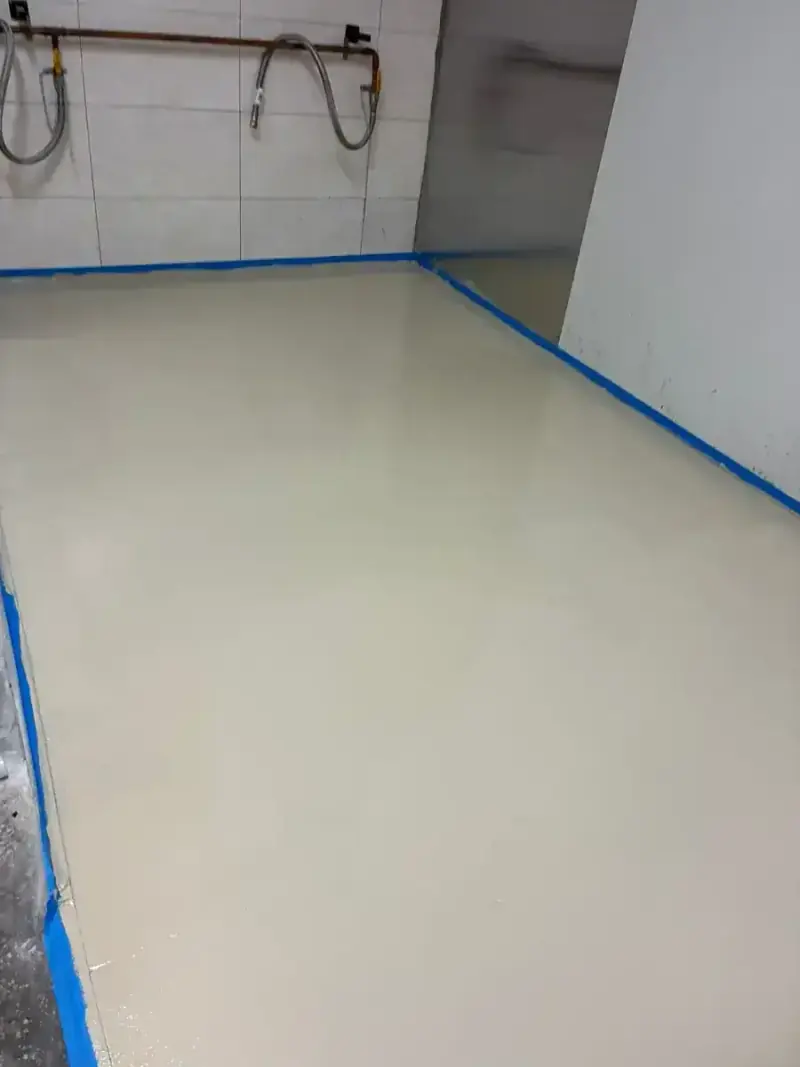
Commercial kitchen floors fail faster than almost any other floor. They are hosed down daily, hit with hot water, fats and degreasers, and expected to stay non-slip the whole time. Tiles and grout rarely survive it for long. Here is what works instead.
What a commercial kitchen floor has to do
- Seamless: no grout lines where bacteria and grease collect
- Slip resistant when wet: textured aggregate in the topcoat
- Chemical resistant: stands up to fats, acids, sanitisers and degreasers
- Easy to clean: can be hosed, scrubbed and squeegeed to drains
- Fast to install: so the kitchen is not closed for long
Why tiles and grout keep failing
Grout is porous. Hot water, fats and harsh cleaners slowly break it down, tiles start to drum and lift, and every missing grout line becomes a place for bacteria. Re-grouting buys time, but the problem comes back.
How a seamless epoxy system works
After the old tiles come out, the slab is diamond ground to open the surface. Cracks and drains are detailed, a penetrating primer goes down, then a heavy-duty resin body coat, anti-slip aggregate and a sealing topcoat. The result is one continuous surface with no joints to fail.
For commercial kitchens, falls to drains and the junction where floor meets wall need the most attention, because that is where water sits.
Chemical-resistant flooring beyond kitchens
The same approach suits workshops, wash bays, laboratories, breweries and food production. The key is matching the system to the chemicals actually used on site. Tell us what gets spilled, how hot it is and how the floor is cleaned, and we will specify the resin and topcoat to suit.
Downtime and cure times
Most small and medium kitchens can be done over a few days. Light foot traffic is usually possible after about 24 hours, with full chemical resistance a few days later depending on temperature and the system used. We plan installs around trading hours wherever possible.
What it costs
Commercial resin floors are priced per project, because tile removal, slab repair, falls and the system specified all vary. As a starting point, decorative epoxy systems start around $70 per m². Removing the old tiles first typically adds $30 to $50 per m², which our tile removal cost guide covers.
See our commercial and garage epoxy flooring service, or ask for a site inspection and written quote.