
Trade Excellence and Standards
Why Choose SurfacePro Flooring
Floor preparation is the foundation of every successful flooring project. Here is what Brisbane homeowners, tilers, builders and commercial managers get when they book us.
Licensed Company. Master Trade Qualified.
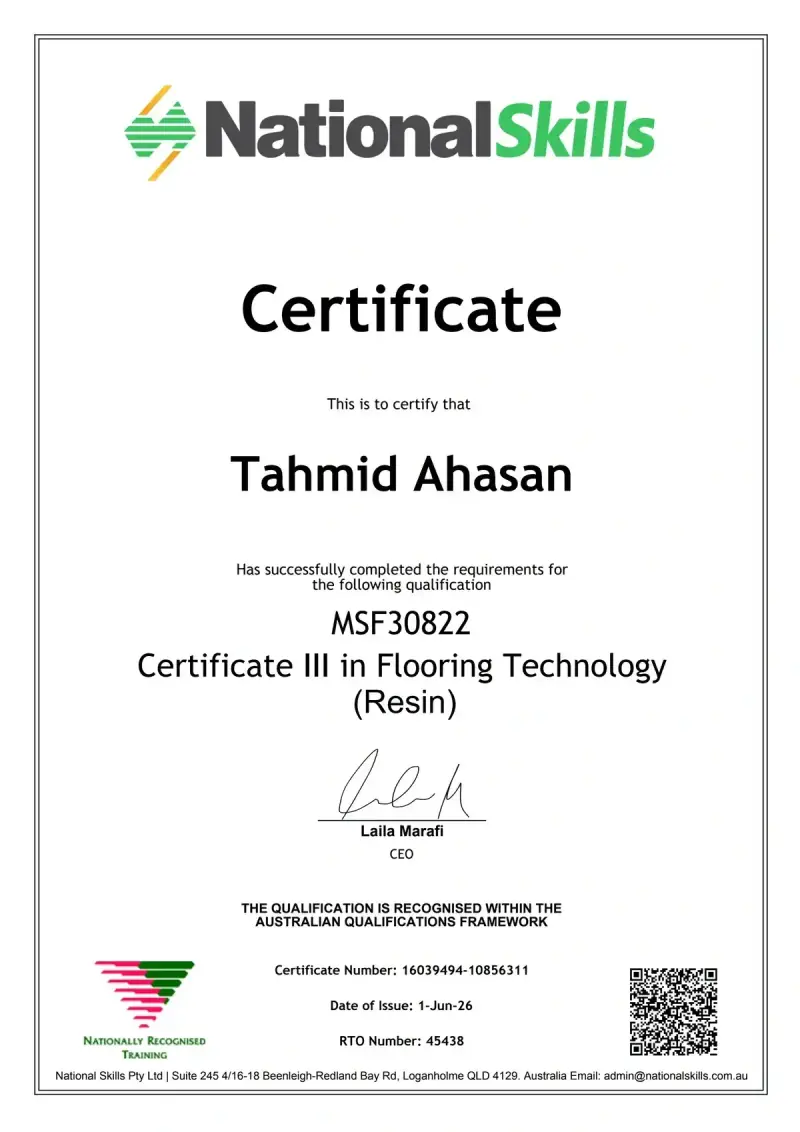
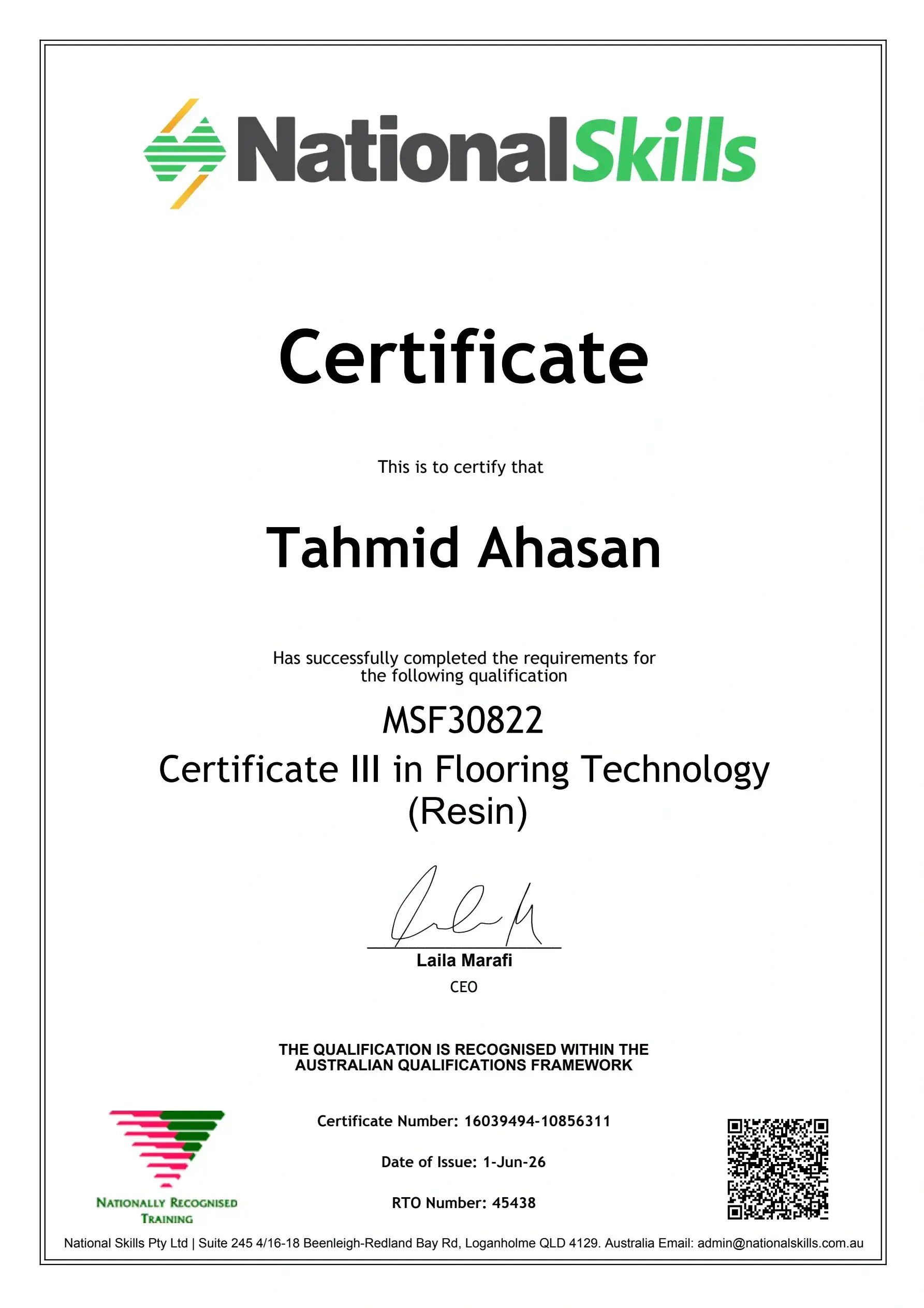
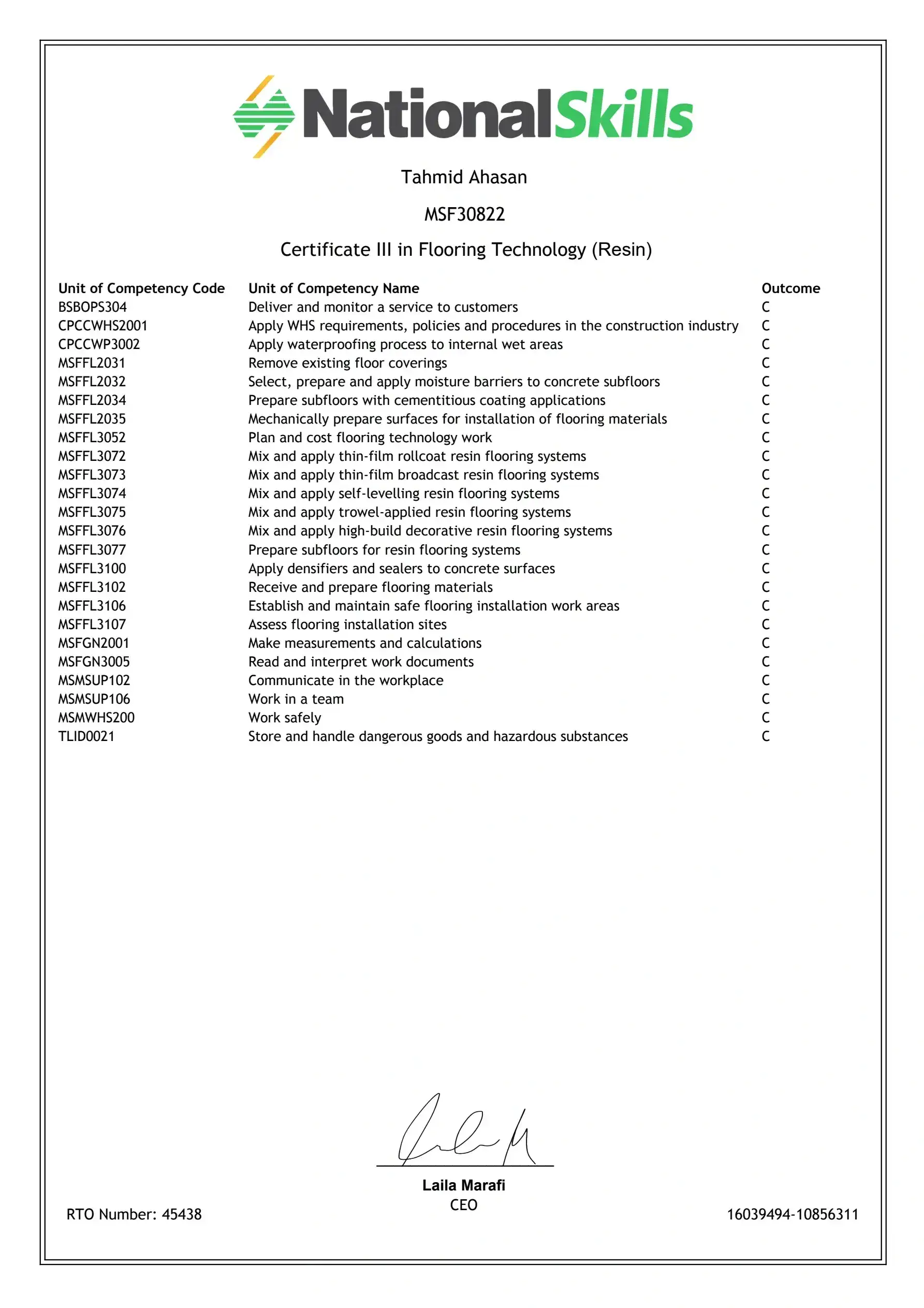
Unlike generic hire-equipment operators or unlicensed handymen, SurfacePro Flooring Pty Ltd holds an official company QBCC Trade Contractor Licence # 15639771 (Floor Finishing and Covering - Hard Sector). Work is executed and personally supervised by master specialist and company nominee Tahmid Ahasan (Nominee Licence # 15639787), backed by the official MSF30822 Certificate III in Flooring Technology (Resin) issued by National Skills (RTO #45438, Certificate #16039494-10856311).
HEPA Dust Extraction
High-airflow multi-stage extractors capture 99% of respirable silica dust at the cutter head, keeping adjacent rooms and tenancies completely clean.
Trade Qualified & Insured
Backed by Tahmid Ahasan’s MSF30822 Certificate III qualification and full $20M public liability insurance. Diamond selection & densifying follow Australian standards.
Industrial Diamond Tooling
Heavy-duty multi-disc HTC planetary grinders matched to the MPA compressive strength of your concrete slab.
Transparent Written Quotes
Itemised written quotes by square meterage and surface condition so you know exactly what you pay for.
Reliable Trade Scheduling
We arrive on time as promised so your tilers, vinyl layers, and builders stay on programme.
Prep & Finish by One Team
Because we execute the subfloor preparation ourselves, your finished floor is never compromised by hidden shortcuts underneath.
Frequently Asked Questions
Do you provide free written quotes?
Yes. Quotes are free, itemised and provided in writing, usually within one business day of us understanding the scope. For larger or more complex jobs we prefer to inspect the site first, because slab condition changes the price and we would rather be accurate than fast.
How much dust does the work actually create?
Far less than traditional methods, but not zero. Our grinders and tile lifters run HEPA-filtered extraction at the point of impact, which captures the large majority of airborne silica dust before it travels. You should still seal off adjacent rooms and remove soft furnishings from the work area, and we will tell you exactly what to prepare before we arrive.
Are you qualified and insured?
Yes. Founder Tahmid Ahasan holds the MSF30822 Certificate III in Flooring Technology (Resin), and we carry public liability insurance. We are happy to provide our certificate of currency before work starts.
What is the difference between concrete sealing and polishing?
Sealing applies a protective product to the surface of the concrete. Mechanical polishing changes the concrete itself, hardening it with a densifier and refining it with progressively finer diamonds. Because a polished finish is part of the slab rather than a film on top of it, there is nothing to peel or flake, and no recoating cycle. Sealing is faster and cheaper; polishing lasts longer and wears better.
Will my slab suit polished concrete?
Most will, but the achievable finish varies. Aggregate depth determines how much stone can be exposed, and existing patches, penetrations and crack repairs stay visible in the finished floor because polishing reveals the slab rather than covering it. We assess these before quoting and show you what to realistically expect.
Do you remove the tile adhesive as well as the tiles?
Tile removal lifts the tile and the loose bedding. Grinding off the remaining adhesive and thinset back to a flat, bondable slab is a separate step, quoted as tile stripping. If your next floor covering is vinyl, timber or a coating, you almost certainly need both, and we will say so in the quote rather than leaving you to discover it later.
How long does a garage epoxy floor take to cure?
Typically light foot traffic after about 24 hours and vehicle parking after 48 to 72 hours, depending on Brisbane humidity and temperature at the time. Cooler or more humid conditions extend it. We will give you specific times for your system on handover.
Why does epoxy sometimes fail, and how do you avoid it?
Almost always because of preparation, not the product. Epoxy applied over a sealed, polished or damp slab has nothing to bond into and eventually lifts in sheets. We diamond grind to an open profile, repair cracks and joints, and check moisture before any product goes down. That preparation is the part of the job that determines whether the coating lasts.
Can worn timber floors be restored rather than replaced?
Usually, and for a fraction of replacement cost. Solid hardwood can be sanded back multiple times over its life. Cupped boards, opened gaps and water damage need addressing before coating, and we will tell you honestly if a floor is too far gone or too thin to sand again.
Which concrete sealer should I choose?
It depends on the surface and the look you want. Penetrating silane sealers soak in and leave the appearance essentially unchanged, which suits exposed aggregate and stone. Acrylics add sheen and deepen colour but wear in traffic areas and need recoating. Polyurethane gives the hardest finish for commercial floors. We will walk you through the trade-offs for your slab.
Can you grind the slab to a specification for our flooring installer?
Yes. Builders and flooring contractors make up a good portion of our work. Give us the required surface profile or flatness tolerance and we will grind to it. Where grinding alone will not bring the floor within tolerance, we will tell you and quote levelling separately.
How soon can you start?
Usually within one to two weeks, depending on the size of the job and where it sits in the schedule. Urgent work can sometimes be accommodated, particularly if you are holding up other trades. Give us a call and we will tell you honestly what is available.
How much does polished concrete cost per m² in Brisbane?
In 2026, standard Grind & Seal in Greater Brisbane costs between $50 and $75 per m², while true Mechanically Polished Concrete (MPC) ranges from $90 to $140 per m² depending on aggregate exposure (nil exposure, semi-exposure, or full stone) and desired sheen level (matte, satin, or high-gloss).
How much does floor tile removal cost in Brisbane?
Standard floor tile removal in Brisbane costs between $30 and $50 per m² including heavy debris cartage and disposal. Removing remaining tile adhesive and thinset bed via diamond glue grinding adds $20 to $25 per m², providing a clean, flat, bondable slab ready for new flooring.
How much does garage epoxy flooring cost in Brisbane?
Professional garage epoxy flake flooring in Brisbane averages $65 to $95 per m² for a standard double garage (~36m²: $2,400 to $3,400 total). Pricing includes diamond grinding surface preparation, crack and divot repair, full decorative flake broadcast, and a UV-stable clear polyaspartic topcoat resistant to hot tyre pickup.
How much does timber floor sanding and polishing cost in Brisbane?
Hardwood timber floor sanding and polishing across Brisbane typically ranges from $45 to $75 per m² for standard 3-coat polyurethane finishes. Punching and puttying nails, board replacements, and premium commercial low-VOC water-based finishes range from $65 to $90 per m².
Still have a question? Get in touch or browse our services.
Ready to get your floors prepped right?
Tell us the suburb, the floor area and what you are after. We will come back with a clear, written quote.