
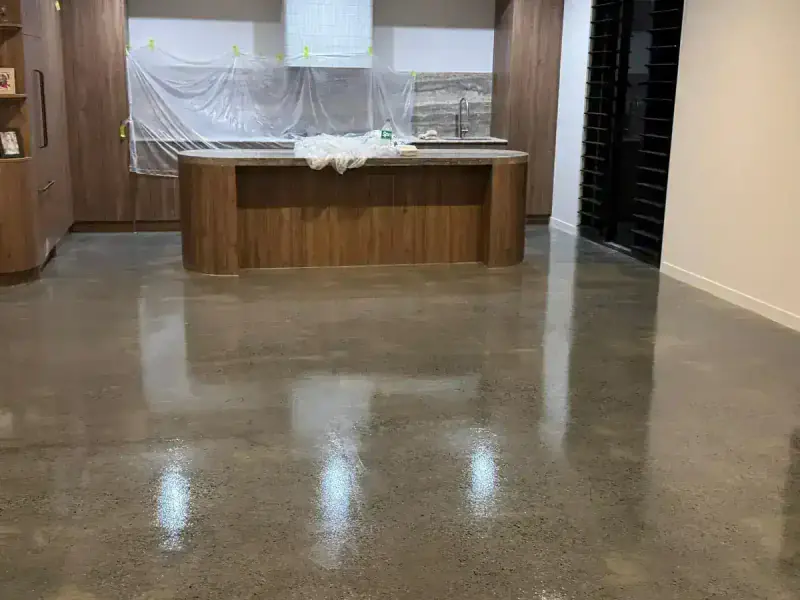
Polished concrete gets specified constantly in Brisbane renovations, and it is often misunderstood. People use the term for two quite different products at very different price points, then get surprised when the quotes come back hundreds of dollars per square metre apart.
Grind and seal is not mechanical polishing
Grind and seal means exactly that: a light grind to flatten and clean the slab, then a sealer applied over the top. It is quick, it is the cheapest option, and it suits garages, warehouses and back-of-house areas well. The trade-off is that the finish is a film sitting on the concrete, so it wears where traffic concentrates and needs recoating every few years.
Mechanical polishing changes the concrete itself. A chemical densifier hardens the surface, then progressively finer diamond abrasives refine it through multiple passes until it reflects light. Nothing is sitting on top, so there is nothing to peel, and no recoating cycle. It costs considerably more and lasts far longer.
Finish levels, and what they actually look like
Two decisions drive appearance, and they are independent of each other.
Aggregate exposure is how deep we grind. A cream or minimal-exposure finish stays near the surface and shows little stone. Salt-and-pepper exposes small aggregate evenly. Full stone exposure grinds deeper to reveal the larger aggregate, which gives that terrazzo-like look, but it depends entirely on what is actually in your slab and how deep it sits.
Sheen level is how far we refine after that: matte, satin, or high gloss. Higher gloss reads as more reflective and more formal, and shows dust and footprints more readily in strong side light.
What drives the price
- Floor area. Larger continuous areas are more efficient to grind, so the rate per square metre usually drops as the job gets bigger.
- Number of passes. A matte grind-and-seal is a fraction of the machine time of a multi-pass high-gloss polish.
- Slab condition. Old adhesive, coatings, patching and crack repair all add preparation before polishing can start.
- Access and obstructions. Small rooms, tight corners and fixed joinery mean more hand-held edge work, which is slower than open-floor machine passes.
The slab conditions that limit your options
This is the part worth knowing before you commit. Polishing reveals the slab rather than covering it, so anything already in the concrete stays visible in the finished floor.
Existing crack repairs, plumbing penetrations, old patches and colour variation from different pours all remain. Aggregate depth varies across a slab, so exposure can shift from one area to another. Slabs poured with a heavy trowel finish sometimes have very little aggregate near the surface at all, which caps how much stone you can ever expose.
None of this rules out polishing. It just means the honest conversation should happen at quoting stage, not after the first grinding pass has revealed something nobody expected.
Living with it
Maintenance is genuinely simple: sweep or dust mop, damp mop with a pH-neutral cleaner. Avoid acidic cleaners, which etch the surface. It is hard-wearing rather than indestructible, so grit dragged under furniture will eventually mark it like any floor.
The two things people notice most after moving in are that it is cooler underfoot in Brisbane summers, and that it reflects noticeably more light around the room than the floor it replaced.