
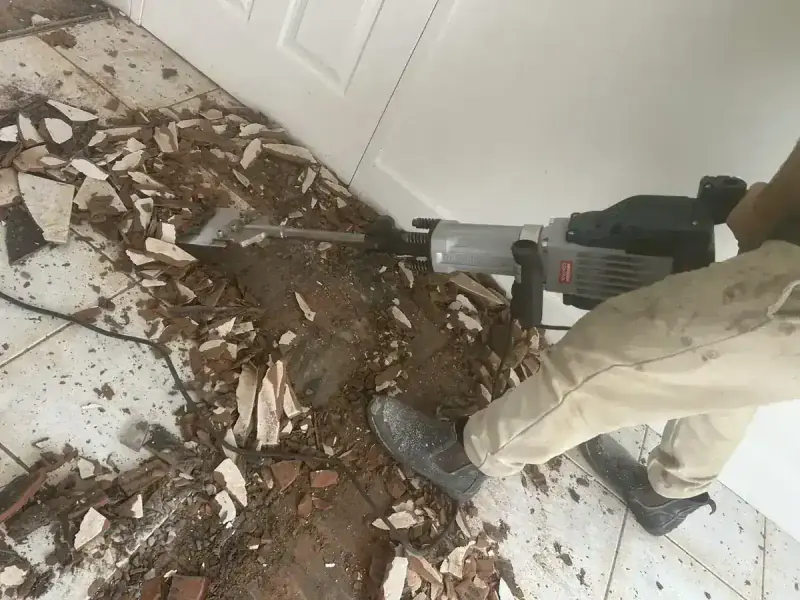
Tile removal is the first step in most renovations, and the step most likely to cause collateral damage. Done the traditional way, it fills a house with fine dust that settles into cupboards, curtains, wardrobes and air conditioning ducts, and keeps reappearing for weeks afterwards.
Why the dust matters beyond the mess
Cutting and breaking concrete and ceramic releases respirable crystalline silica. It is fine enough to stay airborne for hours and to travel well beyond the room being worked in. Australian workplace exposure standards for it have tightened substantially in recent years, and the control that actually works is capturing dust at the source rather than cleaning it up afterwards.
That is the practical difference between a dust-extracted setup and an unmanaged one. Extraction runs at the point of impact, pulling dust into a HEPA-filtered unit before it disperses. It does not eliminate dust entirely, but it changes the scale of the problem from whole-house contamination to something contained to the work area.
Lifting the tile is only half the job
This is where quotes get compared incorrectly. Two distinct pieces of work are involved:
- Tile removal lifts the tile and the loose bedding underneath it.
- Tile stripping grinds off the adhesive, thinset and cutback residue that stays stuck to the slab.
After removal alone, the slab still carries ridged glue. Vinyl planks telegraph every ridge through to the surface. New tiles bond to flexible residue rather than concrete and eventually debond. Coatings lift wherever they could not reach the slab. So if your next floor is vinyl, timber or a coating, you need both steps, and a quote that only covers removal is not comparable to one that covers both.
Protecting the slab
Technique matters as much as dust control. Porcelain and large-format tiles are dense and bond hard; removing them aggressively chips the concrete underneath, and that damage then needs levelling before anything can go back down. Matching the tooling to the tile type and the substrate avoids creating a repair bill that was not in the original scope.
Tiles laid over timber, sheet flooring or hebel are a different job again, and are usually quoted separately, because the substrate cannot take the same approach as a concrete slab.
What to do before we arrive
- Clear furniture, rugs and anything breakable from the work area and the rooms adjoining it.
- Take down curtains and remove soft furnishings nearby, since fabric holds fine dust.
- Empty low cupboards and drawers in the immediate area.
- Turn off ducted air conditioning and close vents in the work zone.
- Plan for the area to be unusable for the duration, and think about pets.
What the slab looks like afterwards
Expect an honest assessment once the tiles are off, because the slab underneath is often the first time anyone has seen it in decades. Old repairs, level variations and moisture issues all show up at that point. We would rather tell you a levelling step is needed than hand over a floor that will fail under whatever goes down next.