
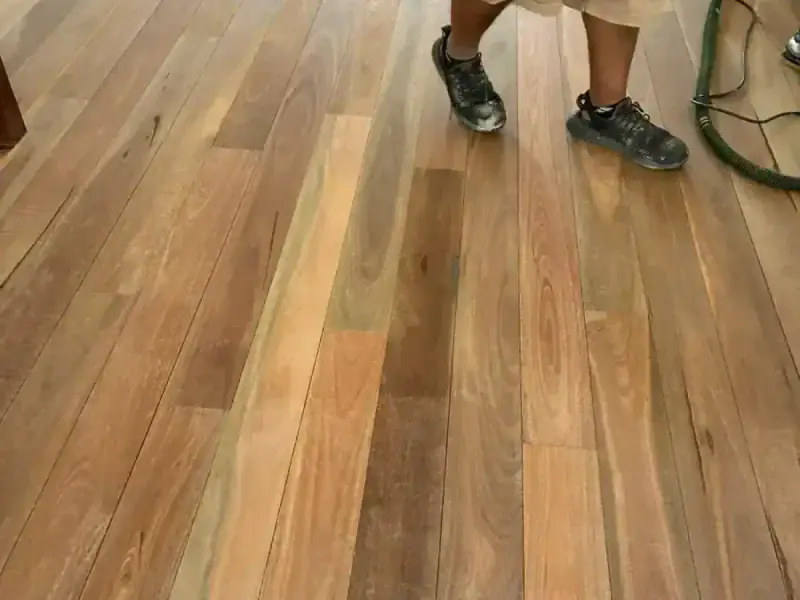
Brisbane housing stock is full of hardwood worth saving. Spotted gum, blackbutt and jarrah sit under decades of yellowed polyurethane in character homes across the inner suburbs, and in most cases sanding it back costs a fraction of replacement while producing a better floor than a new engineered product.
How many times can a floor be sanded?
Solid tongue-and-groove hardwood has usable timber above the tongue, and a full sand typically removes around a millimetre. That generally allows several full restorations across the life of the floor. What limits it is how much has already been taken off, and whether nail heads are approaching the surface.
Engineered timber is different: the wear layer may only allow one light sand, or none at all if it is a thin veneer. Overlay parquetry and older strip flooring both need assessing individually. This is the first thing to check, because it determines whether restoration is even on the table.
What the process actually involves
- Assessment. Board thickness, nail depth, cupping, gaps, water damage and existing coating type.
- Repairs. Damaged or rotten boards replaced, loose boards refixed, squeaks addressed.
- Coarse sanding. Removes the old finish and levels the surface.
- Gap filling where required, matched to the timber.
- Progressive sanding. Finer grits in sequence. Skipping grits leaves marks that only appear once the coating goes on.
- Edges and detail. Perimeters, stair nosings and corners, largely by hand.
- Coating. Multiple coats with light abrasion between them.
Grit sequence and edge work are what separate a floor that reads as flat and even from one that shows drum marks and swirls under low afternoon light. It is the least glamorous part of the job and the part that shows most.
Water-based or solvent polyurethane?
Solvent-based polyurethane is highly durable and ambers the timber, giving a warmer, more traditional tone that continues to deepen with age. The trade-off is strong odour during application and a longer period before the house is comfortable to occupy.
Water-based coatings have far lower odour, cure faster, and stay clear, so the timber keeps its natural colour. Modern two-pack water-based products are comparable to solvent finishes in durability. For occupied homes and families, they are usually the practical choice.
Sheen is separate from that decision: matte, satin, semi-gloss or gloss. Satin is the most common. Higher gloss shows scratches and dust more readily.
Cupping, gaps and moisture
Boards that have cupped, edges lifted higher than centres, are responding to a moisture imbalance. Sanding a cupped floor flat while it is still wet underneath means it will crown once it dries. The moisture source has to be found and fixed first, and the timber allowed to stabilise. Rushing this step produces a floor that looks wrong within months.
Seasonal gapping between boards is normal in Queensland and moves with humidity through the year. Filling gaps at their widest point in the dry season can cause the filler to be squeezed out when the timber expands again.
When replacement is the honest answer
Some floors are past it: too thin to sand again, nail heads at the surface, extensive termite or water damage, or a thin engineered veneer with nothing left to work with. We will tell you when that is the case. Sanding a floor that cannot take it wastes your money and destroys the floor in the process.