
We get called to re-do failed epoxy floors fairly regularly. The coating has lifted in sheets, or it is flaking around the garage door, or hot tyres have pulled it away in patches. Almost none of these failures are caused by the epoxy itself.
Epoxy needs something to grip into
Epoxy bonds mechanically. It needs an open, textured surface to key into, which is why the slab has to be diamond ground to an open profile before anything is applied. Grinding removes laitance, the weak, dusty layer at the very top of a cured slab, along with any old sealer, curing compound or paint.
Applied over a smooth, sealed or polished surface, epoxy has nothing to hold onto. It looks perfect on day one and then releases in sheets months later. Acid etching, which is sometimes offered as a cheaper substitute for grinding, does not achieve the same profile and leaves residue behind if it is not neutralised and rinsed thoroughly.
Moisture is the failure nobody sees coming
Concrete on ground carries moisture up through the slab by capillary action. Seal the top with a coating and that vapour has nowhere to go, so pressure builds at the bond line until the coating blisters or delaminates.
Slabs without an effective vapour barrier underneath, common in older Brisbane housing, are the usual culprits. Testing moisture before coating tells you whether you need a moisture-tolerant primer, a different system, or in some cases a different approach entirely. Skipping the test is gambling with the whole job.
Hot tyre pickup
Warm tyres soften some coatings and pull them off the slab when the car is parked. This is largely a product and preparation question: single-pack water-based products are far more vulnerable than a properly primed 100% solids two-pack system over a correctly ground slab. If you park a daily driver in the garage, the cheap option is a false economy.
Choosing a system
- Solid colour epoxy. Entry level, suits storage areas and light traffic. Simple, uniform appearance.
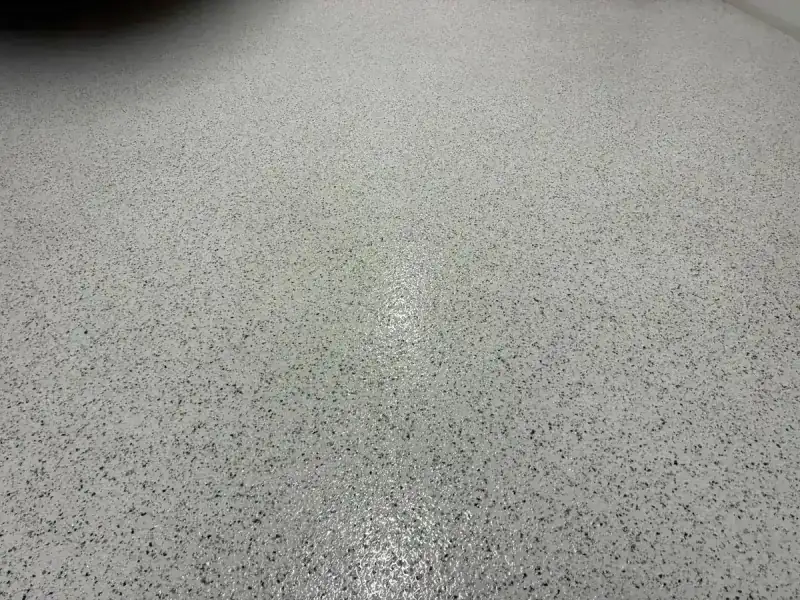
- Flake broadcast systems. The common residential garage choice. Vinyl flake is broadcast into the basecoat and sealed with a UV-stable clear topcoat. Hides minor slab imperfections well and hides dust well too.
- Self-levelling commercial epoxy. A seamless poured finish for kitchens, workshops and labs where hygiene and cleandown matter.
UV stability is worth asking about for any area getting direct sun. Standard epoxy ambers over time; a polyaspartic or polyurethane topcoat holds its colour.
Realistic timeframes
A typical residential garage runs over two to three days: grinding and repairs, then coating, then topcoat. Light foot traffic after about 24 hours, vehicles after 48 to 72. Brisbane humidity extends cure times, and a genuinely cold or damp week extends them further. Anyone promising a full system finished and driven on the same day is cutting something out.